 His period in Milan
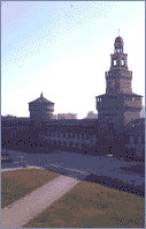 In 1490 Baldassarre Castiglione, then twelve years old, was sent to Milan, to stay with his father’s relations, who held important positions at the court of the Sforzas. The following January, on the occasion of the marriage of Beatrice d’Este to Ludovico il Moro, Baldassare’s parents also came to Milan and, during the celebrations, presented their first born son to Isabella d’Este, the young wife of the Marquis of Mantua Francesco II Gonzaga.
While in Milan, Baldassarre probably stayed in the house of Giovanni Stefano Castiglione, senator and count of Serone, a high ranking diplomat, and under his guidance carried out some excellent humanistic studies: he attended the school of Giorgio Merula for Latin and that of Demetrio Calcondila for Greek. He also took advantage of the magisterial school and of the advice of Filippo Beroaldo il Vecchio, thus gaining a competence in the field of literary disciplines, which, for the parameters of his period, was undoubtedly exceptional.
The city of Milan and the Sforza court were, in the last quarter of the 15 Century, going through a period of exuberant fervour in the arts and in culture, and Baldassarre’s education could not help but be stimulated and nourished by it. Introduced to the court of Ludovico il Moro in 1494, he had the opportunity to meet Leonardo, Bramante, the sculptor Gian Cristoforo Romano, and numerous poets, mostly form the Tuscan school, who all influenced the development of his sense for good taste.
In this period, Baldassarre matured his personality and affirmed his identity as a gentleman and cavalier, in the context of a society that was at the same time demanding and fascinating. This is documented by the pleased and congratulatory words that on 3rd February 1499 Giovanni Stefano Castiglione wrote in a letter to Cristoforo: “I wish to inform Your Magnificence that master Baldassarre, your son, is in good health and well looked upon by our Illustrious Master, and universally by everyone, and deservedly so, because in truth he could not be more polite and virtuous than he is” (V. Cian, Un illustre nunzio pontificio del Rinascimento. Baldassar Castiglione, Città del Vaticano 1951, 14-15).


