 Ippolito Pindemonte
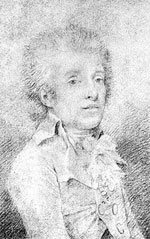 Pindemonte, who was born and lived in Verona (1753-1828), was an important figure on the literary panorama at the end of the 18th and the start of the 19th centuries; he was a friend of Alfieri and Foscolo, witness to the outbreak of the French Revolution [celebrated in his poem La Francia (The France) and present in the novel Abaritte. Storia verissima (Abaritte. Very true story)], the author of verses and prose works that exult the pleasures of the countryside and of solitude [Saggio di poesie campestri (Essay on country poetry), Parma, Stamperia Reale, 1788; Saggio di prose campestri (Essay on country prose)], Verona, Giuliari, 1795).
Foscolo met him in the spring of 1806 when, after returning from France, he spent a long spell in Venice and the surrounding towns. The link between them was their common friend Isabella Teotochi Albrizzi, who often entertained the Veronese writer in her Venetian salon. Pindemonte had started to translate the Odyssey in 1805 and the problem of translating Homer became a subject of discussion between the two writers; in a number of letters Foscolo, who was preparing to publish Esperimento di Traduzione dell’Iliade, called on his friend to dedicate himself to the translation, of which the first two books were published in 1809: Traduzione de’ due primi canti dell’ “Odissea” e di alcune parti delle “Georgiche” (Translation of the first two books of the Odyssey and some parts of the “Georgics”), Verona, Gambaretti, 1809.
But Pindemonte's name is linked, above all, to the writing of the poem Dei Sepolcri, which is dedicated to him; the idea of writing a poem on the theme of tombs was conceived in a conversation Foscolo had with Isabella Teotochi Albrizzi and his Veronese friend who at the time was working on a poem on Cimiteri (Cemeteries). These circumstances created suspicions that Foscolo was guilty of plagiarism and had encouraged his friend to devote himself to the translation of the Odyssey in order to be able to present his poem on Sepulchres as new. However, Pindemonte himself cleared Foscolo of all accusations, saying in a letter that he had had the idea for a poem on cemeteries but had stopped work when Foscolo's poem was published. Cimiteri was published posthumously.








