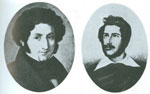
During his stay in Bologna from September 1825 to November 1826 Leopardi consolidated old and made new friendships. He for example consolidated his friendship with Pietro Brighenti (1775-1846), impresario, editor, and a secret confidant for the Austrian police. Leopardi had come into contact with him through Giordani: in 1819 he sent him the Canzoni “rifiutate”/Refused Songs (who were never published at Monaldo’s instigation), and in 1824 published through him the Canzoni; in Bologna Leopardi also became friends with his daughters Anna and Marianna (who was to become an important opera singer), who were later to exchange letters with Paolina.
Among his new friendships, an important one was with Carlo Pepoli (1796-1881), a man of letters and a patriot (exiled after the events of 1831, he was able to return to Italy permanently only in 1859, and was a senator from 1862). Vice-President of the Accademia dei Felsinei, on 28th March 1826 he invited Leopardi, who recited his Epistola al conte Carlo Pepoli: Pepoli “returned the favour” in 1828 publishing the Eremo. Epistola in versi al conte Giacomo Leopardi(Letters in verse to Count Giacomo Leopardi).
An assiduous and affectionate relationship, propitiated by Giordani, Leopardi had with the Tommasini family: the doctor Giacomo, his wife Antonietta, a woman of letters, and their daughter Adelaide, who a married a Maestri.
Lastly, of importance was his relationship with Countess Teresa Carniani Malvezzi (1785-1859), a woman of letters and a translator. Leopardi, alas without being reciprocated, fell in love with her:
Sono entrato con una donna ... di qui, in una relazione, che forma ora una gran parte della mia vita. Non è giovane, ma è di una grazia e di uno spirito che ... supplisce alla gioventù, e crea un’illusione meravigliosa. Nei primi giorni che la conobbi, vissi in una specie di delirio e di febbre. (A Carlo, 30 maggio 1826).
I have entered with a woman ... from here, into a relationship, that is now a great part of my life. She is not young, but she is of a grace and a spirit ... which makes up for youth, and creates a marvellous illusion. In the days I met her, I lived in a sort of delirium and a fever. (to Carlo, 30th May 1826).
When after a while, she, so as to save appearances, decided they should frequent each other less, Leopardi, in a state of delusion and pained, reacted somewhat inelegantly (“How can it enter your head that I might continue to go to that tart of the Malvezzi?”; to Antonio Papadopoli, 21st May 1827).


 The Bolognese