|
 |
Home Page >
Textual pathway > Poems > Inni Sacri: Il Natale
 Inni Sacri: Il Natale Inni Sacri: Il Natale
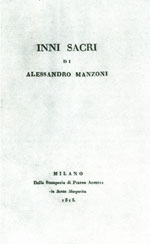 Composed during the summer of 1813, Il Natale (“The Nativity”) is the third of Manzoni’s Inni Sacri, written after La Risurrezione and Il nome di Maria. It celebrates the mystery of God’s Incarnation, with abundant reference to the Holy Scriptures, including the prophet Isaiah, the Book of Job, the Psalms, the Gospels, and ecclesiastical hymnography. Compared with the more “theatrical” sequences of Risurrezione, this hymn has a more narrative pace, and presents the sacred subject matter in stanzas paired by truncated rhyme and with seven-syllable lines ending in paroxytones and proparoxytones. The hymn begins with the effective simile of a boulder that has fallen from a mountain, which no natural force will ever be able to restore to the top: like the boulder, man lay at the depths of his wretched condition after original sin (lines1-21). Lines 29-42 announce the Nativity, with a faithful transposition of the sacred texts (Ecco ci è nato un Pargolo, / ci fu largito un Figlio), and an original impetus of lyricism that echoes the Latin poet Virgil (the trees were once dry, but are now laden with honey) when giving the sense of rebirth of a world that had been abandoned by God. At the centre of the poem (lines 43-56) is a rapt reflection on the unfathomable nature of divine will and the mystery of Grace (an important theme for Manzoni as well as a feature of Jansensim). The final part of the hymn recounts the marvellous event of the birth, with special reference to the humble context of this sublime event (the child’s poor clothing, and the humble inn where he is born, the angel that brings the news to the devout shepherds rather than to the powerful). As well as rhetorical emphasis and pure transcription of its biblical sources, this final part also contains intensely lyrical moments, such as the flight of the host of angels and the “lullaby” (Dormi, o Fanciul, non piangere) sung in solemn harmony with Biblical images (lines 99-112). Composed during the summer of 1813, Il Natale (“The Nativity”) is the third of Manzoni’s Inni Sacri, written after La Risurrezione and Il nome di Maria. It celebrates the mystery of God’s Incarnation, with abundant reference to the Holy Scriptures, including the prophet Isaiah, the Book of Job, the Psalms, the Gospels, and ecclesiastical hymnography. Compared with the more “theatrical” sequences of Risurrezione, this hymn has a more narrative pace, and presents the sacred subject matter in stanzas paired by truncated rhyme and with seven-syllable lines ending in paroxytones and proparoxytones. The hymn begins with the effective simile of a boulder that has fallen from a mountain, which no natural force will ever be able to restore to the top: like the boulder, man lay at the depths of his wretched condition after original sin (lines1-21). Lines 29-42 announce the Nativity, with a faithful transposition of the sacred texts (Ecco ci è nato un Pargolo, / ci fu largito un Figlio), and an original impetus of lyricism that echoes the Latin poet Virgil (the trees were once dry, but are now laden with honey) when giving the sense of rebirth of a world that had been abandoned by God. At the centre of the poem (lines 43-56) is a rapt reflection on the unfathomable nature of divine will and the mystery of Grace (an important theme for Manzoni as well as a feature of Jansensim). The final part of the hymn recounts the marvellous event of the birth, with special reference to the humble context of this sublime event (the child’s poor clothing, and the humble inn where he is born, the angel that brings the news to the devout shepherds rather than to the powerful). As well as rhetorical emphasis and pure transcription of its biblical sources, this final part also contains intensely lyrical moments, such as the flight of the host of angels and the “lullaby” (Dormi, o Fanciul, non piangere) sung in solemn harmony with Biblical images (lines 99-112).
 
|
|
 |
 |
|
|
|
|
|
|
     |