|
 |
Home Page >
Thematic pathway > Authors > Ariosto
 Ariosto Ariosto
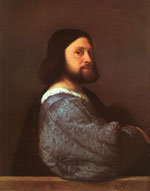 “Leaving aside the early writers and Aristotelian rules, Ariosto has embraced many different actions in his epic, and is read and re-read by people of all ages, men and women, in all languages; everyone enjoys and praises him, his reputation lives on, and he soars gloriously by the tongues of mortals” (translated from T. Tasso, Discorsi dell’arte poetica e del poema eroico, edited by L. Poma, Bari, Laterza, 1964, 22-23). Thus the young Tasso summed up the universal success of the Furioso, its role as poetic model in the second half of the sixteenth century, and its distance from the classical models and Aristotle’s precepts. This dual perspective of successful poetry and considerable eccentricity in terms of poetics characterized Tasso’s work on the epic in the years that followed. In the Discorsi dell’arte poetica, discussing plot construction, Tasso had gently but firmly criticised Ariosto’s epic on two counts, namely, that it was incomplete (as an extension of Boiardo’s Innamorato, from which Ariosto had picked up the narrative threads) and excessive, since Ariosto’s handling of the forty-six cantos of the Furioso rendered them too intricate and complex for the memory of a common reader. For the Gerusalemme, Tasso looked for a solution from within the “precepts of art”, gradually eliminating episodes and adventures overly based on the romance model. Tasso’s letter of 16 January 1577 to Orazio Ariosto, a descendent of the poet (T. Tasso, Lettere, edited by C. Guasti, 5 vols, Florence, Le Monnier, 1852-55, vol. I, 245-246), indicates his desire to pursue an independent project, while still full of admiration for Ariosto’s work, as does his avoidance of polemics against Ariosto during the acrimonious debate with the Crusca stemming from its comparison between the Furioso and the Liberata. “Leaving aside the early writers and Aristotelian rules, Ariosto has embraced many different actions in his epic, and is read and re-read by people of all ages, men and women, in all languages; everyone enjoys and praises him, his reputation lives on, and he soars gloriously by the tongues of mortals” (translated from T. Tasso, Discorsi dell’arte poetica e del poema eroico, edited by L. Poma, Bari, Laterza, 1964, 22-23). Thus the young Tasso summed up the universal success of the Furioso, its role as poetic model in the second half of the sixteenth century, and its distance from the classical models and Aristotle’s precepts. This dual perspective of successful poetry and considerable eccentricity in terms of poetics characterized Tasso’s work on the epic in the years that followed. In the Discorsi dell’arte poetica, discussing plot construction, Tasso had gently but firmly criticised Ariosto’s epic on two counts, namely, that it was incomplete (as an extension of Boiardo’s Innamorato, from which Ariosto had picked up the narrative threads) and excessive, since Ariosto’s handling of the forty-six cantos of the Furioso rendered them too intricate and complex for the memory of a common reader. For the Gerusalemme, Tasso looked for a solution from within the “precepts of art”, gradually eliminating episodes and adventures overly based on the romance model. Tasso’s letter of 16 January 1577 to Orazio Ariosto, a descendent of the poet (T. Tasso, Lettere, edited by C. Guasti, 5 vols, Florence, Le Monnier, 1852-55, vol. I, 245-246), indicates his desire to pursue an independent project, while still full of admiration for Ariosto’s work, as does his avoidance of polemics against Ariosto during the acrimonious debate with the Crusca stemming from its comparison between the Furioso and the Liberata.
 
|
|
 |
 |
|
|
    |





