 Between Francis I and Leo X
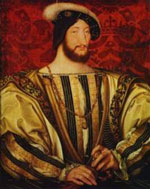 Two new protagonists dominated the political scene in Italy. Pope Leone X, successor to Giulio II, wanted to enlarge the power of his family, and gain for it a dominant position not only in Florence, but also at a national level. The King of France, Frances I, who in 1515 came to the throne after the death of Louis XII, intended to move towards re-conquering Milan, with the help of the Republic of Venice. The state of Urbino, and with it Castiglione, find itself trapped between two forces.
On 14th September, the battle of Marignano, fought by Franco-Venetian troops against the armies of Milan, Switzerland, and the Pope, saw the victory of Frances I, who presented himself as the arbiter of diplomatic equilibrium in Italy. On the one hand, Leone X wanted to obtain his support, to oust Francesco Maria Della Rovere and hand the state of Urbino to his nephew Lorenzo de’ Medici, master of Florence. On the other hand, Castiglione had to make use of all his skills to ensure that this did not happen.
Thus, in the autumn of 1515 he wrote a prologue to the Libro del Cortegiano containing a paean to the king of France, that was aimed, appealing to his responsibilities, at ingratiating himself, and the cause of Urbino, with Frances I. Then, between the 11th and 15th December, he went to Bologna, where Frances I and Leone X had met to find an agreement regarding the fate of Duke Francesco Maria: before the King of France Castiglione presented the case for his prince, who was unjustly threatened by the Pope with excommunication and the confiscation of his state and all his possessions. Then, in the following spring, he returned to Rome in the company of the Duchess Elisabetta Gonzaga, in the hope of convincing the Pope to recede from his intentions.
But all his efforts were in vain, and Castiglione’s diplomatic talent received a serious setback. In fact, in June 1516, with an imperial act, Leone X proscribed and ousted Francesco Maria Della Rovere, and proceeded with the investiture of the new Duke: Lorenzo di Piero de’ Medici, to whom Machiavelli had dedicated the Principe. Baldassarre was forced to follow his masters into exile, in Mantua.


