 Between Cesare Borgia and Lorenzo de' Medici
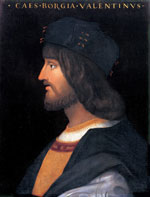 In the spring of 1501, Cesare Borgia enacted a perfect plan that enabled him to get his hands on the state of Urbino and chase away Guidubaldo di Montefeltro, up until then his ally, forcing him into adventurous flight. It is but one of the acts for which the character is praised by Machiavelli in Chapter VII of the Principe: for his ability to use trickery, lying and fiction as instruments suitable for political fighting, for his craftiness in exploiting the benevolence and ingenuity of his allies, aiming to impose himself through treachery. But Machiavelli’s admiration finds its correspondence in Castiglione’s repulsion. In the letter to Henry VII King of England, the event is highlighted in order to condemn the inhuman ingratitude of the Valentino towards those who had assisted him, censoring the crime perpetrated to the detriment of the guiltless Guidubaldo.
One man’s hero (Machiavelli) is the anti-hero of the other (Castiglione), and vice versa: the malignant and perverse nature of Cesare Borgia makes incredible achievements possible, that Machiavelli indicates as a positive example to the readers of the Principe, while Castiglione repudiates those same achievements as treacherous and unjust. The justice, loyalty and gratitude of Guidubaldo appear to Castiglione as the seal of the “good prince”, while for Machiavelli they are a sign of stupidity and idiocy.
It is not by chance that the desires of Machiavelli coincide with the fears of Castiglione: what one fears the other desires. The Principe, in fact, is dedicated to Lorenzo de’ Medici, with the implicit exhortation to follow the road of the Valentino, slyly exploiting the support of the Pope, Leone X, to satisfy his own thirst for power. But the printing and publication of the epistle to the sovereign of England, in 1513, follows an opposite design: denouncing the infamy completed by the usurpers, Alessandro VI and Cesare Borgia, so that Leone X and his nephew Lorenzo would find it repugnant to repeat the same offence. At first the manoeuvre had success. Nonetheless, just a few years later, in June 1516, Leone X and Lorenzo de’ Medici, in the tracks of their predecessors, did what Machiavelli had implicitly suggested: and the imperious act for Castiglione turns into a grave defeat, both personal and e professional.





