The characters of the dialogical fiction
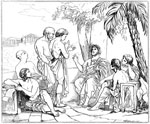 The Cortegiano, compared to the dialogues of the classical and humanist traditions, presents and unusually high number of interlocutors: this is a signal that immediately tells us how the construction of the profile of the perfect gentleman requires the concourse of numerous voices, stories and experiences. Nobody, on his own, could presume to complete the task that the brigade, united around Elisabetta Gonzaga, set itself: the dialectic collaboration of different intellects, on the other hand, not always agreeing with each other, sets up the premise on the basis of which the objective could be reached.
The characters in the work are real, historical, not fictitious: Castiglione uses this stratagem to demonstrate that the subject debated in The Cortegiano does not belong in the field of abstract speculation, but has deeply rooted foundations. The effective application of the ideal proposed in the Libro is guaranteed by the identity of the participants. In each of the four evenings into which the text is divided, one principle character stands out, around which others emerge to solicit the development of the reflections by means of questions and polemical objections. In the first book the conversation is lead by Ludovico di Canossa, with the help of Cesare Gonzaga, Federico Fregoso, Gaspare Pallavicino and others; in the second book the role of Ludovico di Canossa is taken over by Federico Fregoso, while the monographic treatment of the theme of facetiousness is delegated to Bernardo Dovizi da Bibbiena.
In the third book the profile of the perfect lady of the palace is achieved by means of a lively intermingling of the various interlocutors: the celebration of female dignity and of women’s specific virtues is up to Giuliano de’ Medici and Cesare Gonzaga, who rebuff and confute the contrary ideas defended by the misogynists in the company, Gaspare Pallavicino, Ottaviano Fregoso and Niccolò Frisio. The political discussion that occupies the first part of the fourth book is entrusted to Gaspare Pallavicino, while the exposition of a monologue on love is the responsibility of Pietro Bembo.