 The court of Guidubaldo
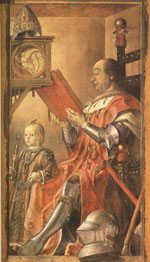 Il libro del Cortegiano introduces itself, right from the first pages of the dedication to Miguel da Silva, as a “ritratto di pittura della corte” (painted portrait of the court) of Guidubaldo di Montefeltro, Duke of Urbino (B. Castiglione, Il Cortigiano, edited by A. Quondam, Milan 2002, I, 5). The whole work, the elaboration of which Castiglione worked on for nearly two decades, evokes the splendours of the era, which ended dramatically in 1508 with the premature death of the prince, and all the characters of the dialogues correspond to the numerous gentlemen, artists and literary men who, in the early 16th Century, with their material presence at the court of Urbino decreed the excellence of the Montefeltro court.
However, as is pointed out at the start of the work, Guidubaldo does not participate in the conversations, which are thought to be dated March 1507, because “continuamente, per l’infermità, dopo cena assai per tempo se ne andava a dormire” (due to sickness, after dinner he always went to bed early) (B. Castiglione, Il Cortigiano, edited by A. Quondam, Milan 2002, I, 16). The people of his court carry on the dialogues, that aim to define the profile of the perfect courtier, but not by the Duke himself, who, due to infirmity, was constricted to bed. Thus there is an observation in the work that Castiglione made also in the epistle to Henry VII: Guidubaldo, in the presence of the imposing figure of his parent, from whom he inherited his state, is the prototype of the sick and unfortunate prince, who tragically exemplifies the contrast between his natural virtues, and the expectations stemming from them, and fortune, that for him has always been “invidiosa” and “perversa”.
The exuberant personality of the father Federico is replaced, as pointed out in The Cortegiano, by the tenaciously pensive, and veiled in melancholy, personality of the son, Guidubaldo, who, not being able to lead in matters of war, imposed himself via the art of reason and of judgements on the qualities of others. The dyptich, placed at the start of Castiglione’s Libro, exhausts the spectrum of all the qualities of every great sovereign: next to Federico, the glorious Duke, voted to success in every enterprise, stands the son Guidubaldo, who, rather than collapsing under the harsh blows of destiny, is stimulated by them to exercise his own wisdom and, by this means, shape his own court.





