 The contents of the eclogue
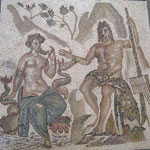 The Tirsi is a representative "egloga", a poetic composition of pastoral nature destined for recitation, or representations, in front of the most illustrious members of the court of Montefeltro. It was a type of entertaiment common in Urbino and the other courts of the time, at least from the start of the 15th Century. The work was dedicated to the Duchess Elisabetta Gonzaga, by means of a prologue in the form of a letter that introduced the text, signed only by Cesare Gonzaga. The protagonists are three shepherds, Iola, Tirsi and Dameta, who, chatting amongst themselves against an idyllic country background, explicitly evoke, hidden in the bucolic disguise, real places and people: starting with the ducal palace of Urbino and its princes, Guidubaldo and Elisabetta. The text thus turns out to be a shameless and direct exaltation, though always elegant, of the court of the dukes. The Princess, in particular, is repeatedly celebrated, so much so that it is the homage and praise given to the lady that constituted the fundamental reason that justified the genesis of the composition.
The plot of the poem was as follows: after the lament of the shepherd Iola, rebuffed by the nymph Galatea, Tirsi speaks, telling him that he had left his homeland due to his desire to see and get to know a goddess, a woman whose virtue and beauty are praised by all. The shepherd Dameta takes over and, with a series of transparent allusions, produces the elegy of the goddess (Elisabetta Gonzaga), of her nymphs (the ladies of the court) and of the shepherds that honour her (Pietro Bembo, Giuliano de’ Medici, Ludovico di Canossa and others). At the end homage is paid to the “bon pastore” (good pastor), that is the Duke Guidubaldo di Montefeltro. Tirsi, intrigued and impatient, is entertained by Dameta, who invites him to listen to the chorus of shepherds that are arriving, and to watch a dance, with the promise that he will soon be able to see the goddess and her nymphs.
The transfer of the historical fact into the land of poetry was functional to the economastic and mythical transfiguration of the court of Urbino, that, started in this work, reached its peak in Castiglione’s literary work in The Cortegiano.





